
Buyer's Guides › Multi-Engine Piston
How to Buy a Diamond DA42 TwinStar / NG / VI: Buyer's Guide
A modern, efficient composite light twin that burns Jet-A. Engine generation and logbook history matter more than model year.
Updated October 2026 · Market data from 28 live fyiAero listings, the FAA registry and NTSB records
Overview
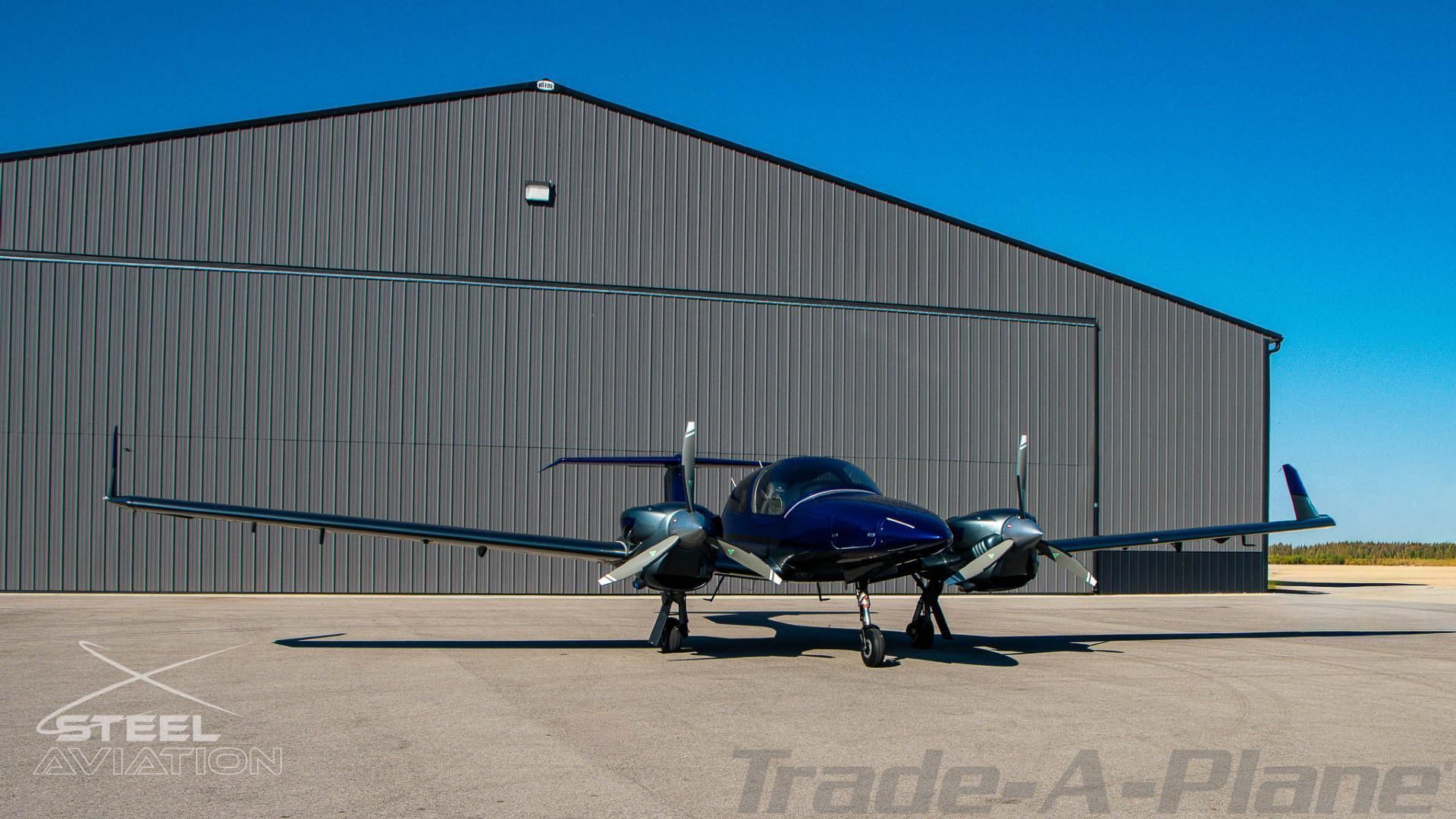
The Diamond DA42 brought the light twin into the glass-cockpit, composite-airframe era. It has a carbon and glass fiber airframe, a long high-aspect wing, Garmin G1000 avionics, and two FADEC-controlled diesel engines run by a single power lever each. There is no mixture and no prop lever. It burns far less fuel than a legacy piston twin and runs on Jet-A. That combination made it a favorite of flight schools, government operators, and owner-pilots who want twin redundancy without a Baron-sized fuel bill.
The family splits into distinct generations that trade very differently. Early TwinStars left the factory with Thielert Centurion 1.7 diesels, and many were later converted to the Centurion 2.0 or to Austro AE300 engines. The DA42 NG introduced the Austro AE300. The DA42-VI refined the aerodynamics and systems and is still in production. fyiAero listings currently show 28 aircraft for sale, about 11 percent of the 261 DA42s on the FAA registry. That is a deep market for a twin this size. Most available inventory is NG and VI models, with a handful of earlier TwinStars and TDI-designated airplanes.
Asking prices on fyiAero run from $289,900 to $1,330,940, with a median of $860,000. Listed model years span 2006 through a new-production airplane advertised as a 2027 model, and median airframe time is 1,464 hours. Expect wide spreads within the same model year. Engine type, engine time, ice protection, avionics, and training history drive value more than the calendar.
Who it's for. The DA42 suits a pilot who wants a modern twin for regional IFR travel at roughly 150 to 170 knots, a multi-engine time builder, or a flight school or club that needs a fuel-efficient multi trainer. It is docile and easy to fly by twin standards, and the single-lever FADEC removes a lot of workload. It still demands real multi-engine proficiency, and the engine systems, gearboxes, and electrical dependence are unfamiliar to pilots raised on Lycomings. Insurers generally want a multi-engine rating, solid total time, and some multi time before quoting reasonable terms to a low-time twin pilot. Expect a factory or Diamond-specialist checkout to be required, plus recurrent training. Get insurance quotes before you make an offer, especially if you are new to twins. Fully loaded with fuel, it is closer to a two-plus-two airplane than a true four-seater, so run the weight and balance for your actual mission.
Generations and variants
| Version | Years | What changed |
|---|---|---|
| DA42 TwinStar (Thielert Centurion 1.7 / 2.0) | 2004-2008 | The first production airplanes used Thielert Centurion diesels, and many 1.7-powered aircraft were later converted to the Centurion 2.0 or the Austro AE300. Engine program support, replacement-interval status, and conversion history decide these airplanes' value, which is why they make up most of the low end of the market. |
| DA42 L360 (Lycoming) | approx. 2008-2010 | This small run used conventional avgas Lycoming IO-360 engines, largely in response to the Thielert supply problems. They are rare on the market and give up the diesel's fuel economy, but they appeal to buyers who want familiar engines and conventional overhaul shops. |
| DA42 NG | approx. 2010-2012 | Diamond switched to its own Austro Engine AE300 diesels, which have more power and better high-altitude and useful-load performance than the Centurion. NGs trade well above early TwinStars and anchor the middle of the market. |
| DA42-VI | approx. 2012-present | This version refined the aerodynamics, cowlings, props, and systems for better speed and efficiency, and later airplanes received Garmin G1000 NXi avionics. Recent VIs and new-production aircraft occupy the top of the price range. |
What a Diamond DA42 TwinStar / NG / VI costs to buy
15 priced listings on fyiAero right now ask between $289,900 and $1,330,940, with a median of $860,000 and a median of 1,464 hours total time. Against fyiEstimate, 3 are priced below estimate, 2 within range and 5 above.
- Shop by engine first and year second. Early TwinStars with original or converted Centurion engines account for the low end, and fyiAero listings show 2007 airplanes averaging about $563,450 across four examples. NG and VI airplanes from 2017-2018 average around $906,000 to $916,000.
- Late-model airplanes command a clear premium. 2020 and 2021 listings average roughly $1.1 million, and a new-production airplane is listed at $1,330,940. On fyiAero, low-time airframes under 1,000 hours carry a median of $933,750.
- Airframe hours alone do not set price. In current fyiAero listings, airframes with 1,000-2,000 hours carry a median of $633,080, but airplanes with 5,000+ hours carry a median of $662,450. Those high-time airplanes are usually ex-trainer NG or VI models with newer engine generations, so read the engine and gearbox records, not just the tach.
- Treat a high-time ex-training airplane as a different product from an owner-flown one. Training airframes can be well maintained on tight schedules, but they see more cycles, hard landings, and gear wear. Price them accordingly and inspect them harder.
- Value the equipment that matters for your mission. Full known-ice (FIKI) TKS protection, a GFC 700 autopilot, G1000 NXi, and synthetic vision all move price, and ice protection is a big one for real-world IFR use.
- With 28 airplanes on the market against a fleet of 261, you have choices. Do not overpay for a weak engine-time position because the paint and interior look good.
Average asking price by model year
Median asking price by airframe time
| 0–1,000 hrs | $933,750 | 6 listings |
| 1,000–2,000 hrs | $633,080 | 3 listings |
| 2,000–3,000 hrs | $644,000 | 2 listings |
| 5,000+ hrs | $662,450 | 2 listings |
Pre-buy inspection checklist
Have a shop that knows the type do the pre-buy, and ask them to research every applicable AD and service bulletin. Pay particular attention to:
- Engine type, conversion history, and time remaining. Diesel engines on the DA42 run on time-between-replacement or overhaul schedules that differ from conventional avgas engines. Confirm exactly which engine model is installed, its hours and calendar status, and the cost to reach the next replacement or overhaul. That number can swing value by six figures.
- Gearbox and clutch inspection records. Both the Centurion and the AE300 drive the propeller through a reduction gearbox with periodic inspection and replacement requirements. Missing or overdue gearbox work is a red flag and an expensive fix.
- FADEC/ECU data download and fault history. Have a qualified shop download engine control unit data to review fault codes, exceedances, and how the engines have actually been operated. Recurring A/B channel faults or overtemps tell you more than the logbook narrative.
- Composite airframe condition. Inspect for cracks, delamination, impact damage, UV degradation, and paint condition, especially around the gear attach areas, wing roots, nacelles, and control surface hinges. Composite repairs must be done to Diamond standards, so look for quality and documentation.
- Landing gear, actuators, and hydraulic system. The electro-hydraulic retractable gear takes a beating in training use. Check the trailing-link main gear, nose gear components, actuators, the power pack, and the emergency extension system, and review any gear-up or hard-landing history.
- Propellers. The composite constant-speed props have specific inspection, erosion, and overhaul requirements. Check blade leading edges, de-ice boots if installed, and overhaul status. Have the shop research all applicable propeller ADs and SBs.
- TKS ice protection system. On equipped airplanes, verify panel condition, pump function, fluid tank and lines, and whether the installation is approved for full known ice or is a non-hazard system. Repairs to porous panels are costly.
- Electrical system and ECU backup batteries. The FADEC engines depend on electrical power. Check alternators, main and backup batteries, the engine ECU backup batteries, and bus wiring, and confirm the electrical-failure checklist items function as designed.
- Canopy, doors, and latching. Check the canopy and rear door latching mechanisms, warning systems, seals, and any cracking in the canopy or windows. Confirm that applicable factory modifications to the latching and warning systems are complied with.
- AD, SB, and Diamond mandatory service compliance. The DA42 has a significant body of engine, airframe, and propeller service information that varies by engine and serial number. Have a Diamond-experienced shop research every applicable AD, SB, and mandatory service bulletin and verify compliance in the logs.
Popular upgrades
- AE300 engine conversion on early TwinStars. Converting older Centurion-powered airplanes to Austro AE300 engines significantly improves performance and parts support. A converted airplane usually trades well above an unconverted one, though still below a factory NG or VI.
- Garmin G1000 NXi upgrade. Upgrading older G1000 installations to NXi brings faster processors, better displays, and modern features. Buyers pay for it, but it rarely recovers its full cost at resale.
- GFC 700 autopilot. Early airplanes often have the KAP 140, while later ones have the integrated GFC 700 with coupled approaches and envelope protection. The GFC 700 is strongly preferred by owner-pilots and insurers.
- Full known-ice TKS protection. Approved FIKI protection adds real utility for IFR travel and holds value well. Non-FIKI systems are worth less.
- ADS-B, synthetic vision, and connectivity. ADS-B In/Out compliance is now expected. Synthetic vision, Connext, and Bluetooth database updates are nice-to-haves that help a listing stand out.
Ownership costs
fyiAero does not currently have a reliable operating cost estimate for the DA42, so budget conservatively. The big variable is engine reserves. Diesel engines have defined replacement or overhaul intervals and gearbox inspections, so price the cost per engine hour from the shop's quote for your specific engine model, not from avgas-twin rules of thumb. Fuel is the DA42's strong suit: it burns modest amounts of Jet-A compared with a legacy piston twin, which is often cheaper per gallon and widely available. Annuals on a composite twin with G1000, retractable gear, and possibly TKS are not inexpensive, and you will want a Diamond-experienced shop. Add hangar, insurance (higher for low-time twin pilots), avionics database subscriptions, prop overhauls, and TKS fluid if equipped. Get engine, gearbox, and prop status into dollars before you negotiate.
Safety record
NTSB records show 15 DA42 accidents in the U.S. over the last 10 years, one of them fatal and none listed as destroyed. Against a registered fleet of 261, that works out to about 57.5 accidents and 3.8 fatal accidents per 1,000 aircraft over 10 years. Keep in mind that a large share of the fleet flies in flight-training environments with frequent takeoffs, landings, and engine-out practice, which increases exposure to minor mishaps. The low fatal and destroyed counts are consistent with a docile airplane and a crashworthy cabin. The type-specific risk areas are the classic twin ones plus a few unique to the diesels. Train for engine failures and practice proper single-engine technique and Vmc awareness. Learn the FADEC and electrical failure procedures thoroughly, since the engines depend on electrical power. Watch gear management, because gear-up and gear-related landing mishaps show up in training fleets. Respect icing limits on airplanes without FIKI approval. A checkout with an instructor who knows the DA42, plus regular recurrent training, is the best risk reducer.
Alternatives to consider
- Piper PA-44 Seminole. It has conventional Lycoming engines that any shop can maintain and usually costs less to buy. It burns avgas, is slower, has an older airframe design, and lacks the DA42's efficiency and modern feel.
- Beechcraft Baron 58 / G58. It offers more power, useful load, cabin space, and speed, plus a huge support network. Fuel burn and operating costs are much higher, and a late-model G58 costs considerably more.
- Piper PA-34 Seneca. It has a roomier six-seat cabin and turbocharged Continentals for altitude. It burns avgas at a higher rate and is a heavier, more workload-intensive twin to fly.
- Tecnam P2006T. It is a lighter, less expensive light twin with avgas or mogas-capable Rotax engines that is popular with schools. It is slower, less capable for serious IFR travel, and offers less airframe and avionics capability.
- Diamond DA62. It is the DA42's bigger sibling, with more cabin, payload, and power from the same jet-fuel engine family. It costs much more to buy and has a smaller used market.
Frequently asked questions
How much does a used Diamond DA42 cost?
fyiAero listings currently range from $289,900 to $1,330,940, with a median asking price of $860,000. Early TwinStars sit at the low end, recent DA42-VIs fall around $900,000 to $1.1 million, and a new-production airplane is listed at the top.
What is the difference between the DA42, DA42 NG, and DA42-VI?
The original DA42 TwinStar used Thielert Centurion diesels, and the NG switched to more powerful Austro AE300 engines. The VI added aerodynamic and system refinements to the AE300 platform and later received G1000 NXi avionics, which is why VIs bring the highest prices.
Does the DA42 really run on jet fuel?
Yes. The diesel-powered versions burn Jet-A, which is widely available and often cheaper than avgas, and they burn noticeably less fuel than a comparable avgas twin. The rare Lycoming-powered L360 version is the exception and burns 100LL.
Is a high-time DA42 a bad buy?
Not necessarily. On fyiAero, airplanes with 5,000+ airframe hours carry a median of $662,450, close to airplanes with 1,000-3,000 hours, because many are ex-training NG or VI models. Engine, gearbox, and prop status and the quality of the maintenance records matter more than total airframe time.
Is the DA42 a good airplane for building multi-engine time?
It is one of the more economical twins to fly per hour thanks to low fuel burn, and it is forgiving and easy to fly. Insurance for low-time twin pilots can be expensive, so get quotes first and plan on a formal checkout.
How safe is the Diamond DA42?
NTSB records show 15 accidents over the last 10 years, one of them fatal, against a U.S. fleet of 261. That works out to about 57.5 accidents and 3.8 fatal accidents per 1,000 aircraft. Much of the fleet is used in training, and the low fatal count reflects a docile airplane, but engine-out proficiency and gear management still matter.
Diamond DA42 TwinStar / NG / VI for sale
 📷 89
 📷 20
 📷 2
 📷 124
Prices, fleet and safety figures update automatically from fyiAero listings, the FAA aircraft registry and NTSB data. The editorial was written by fyiAero with AI assistance from that data and general type knowledge. It is not a substitute for a pre-buy inspection, title search or professional advice.
